
Criminal Court Records in Beaver County
A criminal court record is the case file the court clerk opens once charges are filed against a person. In Beaver County, the elected Court Clerk keeps these files for the District Court. The clerk records and stores a permanent copy of each step in the case. The file sits in the court's criminal division, next to civil, probate, juvenile, and small claims matters. It is not the same as an arrest report or a jail booking sheet. Those stay with the Sheriff. The court record starts later, when the State of Oklahoma formally charges the defendant and the case gets a number.
Beaver County District Court hears criminal cases of all kinds. It sits in Oklahoma Judicial District 1, which also covers Cimarron, Harper, and Texas counties. The District Court handles both felonies and misdemeanors. A felony is a serious crime that can bring a prison term. A misdemeanor is a lesser offense with a shorter jail term or a fine. City ordinance violations are different. Those go to the Beaver Municipal Court, not the District Court, so they will not show up in a District Court case search.
How to Search Beaver County Criminal Records
Most Beaver County criminal court records are searched online through On Demand Court Records, the portal the county links as its court source. ODCR is free to search and view for public court cases. The Oklahoma State Courts Network, known as OSCN, is the statewide backup. Beaver County District Court is listed in both systems. ODCR records reach back to 1997, and new activity is processed each hour.
- Open ODCR and set the court group to Oklahoma District Courts, then choose Beaver as the court.
- Search by the defendant name entered as last name first, or type a full case number if you have one.
- Narrow the search by case type, such as Criminal Felony Proceedings or Criminal Misdemeanor Proceedings, and add a filing date range.
- Open a matching result to read the docket, the charges, the plea, and the disposition.
- Ask the Court Clerk for a certified copy when you need an official document for court or legal use.
OSCN also posts daily docket reports and lets you pull a case by its number, such as CF-2014-1. If a case does not appear online, it may be sealed, juvenile, or simply not digitized. For a closer look at the charges themselves, the Beaver County court charge records page breaks down how an accusation is filed and amended.
Note: ODCR shows free docket information, but full case documents and certified copies still come from the Court Clerk for a copy fee set by that office.
Who Files Beaver County Criminal Charges
An arrest does not create a criminal court case by itself. The District Attorney decides whether to file charges, reduce them, or decline the case. District 1 covers Beaver, Texas, Cimarron, and Harper counties, and George H. Leach III serves as the District Attorney. His office acts as the chief prosecutor for all four counties.
Charges become court records when the prosecutor files them in the District Court. Until then, an arrest stays with the Sheriff as a booking record. The filing document is often called an information, which is the prosecutor's formal written charge in most Oklahoma criminal cases. Once filed, the case gets a number, and the clerk opens the file the public can search.
Note: A case marked Criminal Proceedings - Not Filed means the prosecutor reviewed an arrest but did not bring formal charges in the District Court.
Stages of a Beaver County Criminal Case
A criminal case moves through set stages, and each one leaves a mark in the record. The docket lists every step in order, with dates. Reading the stages helps you tell where a case stands and what comes next.
Case flow: Charges Filed › Arraignment › Pretrial / Motions › Plea or Trial › Disposition › Sentencing
| Stage | What Happens |
|---|---|
| Arraignment | The first formal court appearance, where the defendant hears the charges and enters a plea of guilty, not guilty, or no contest. |
| Pretrial / Motions | Lawyers exchange evidence and file motions, which are requests asking the judge to rule on issues before trial. |
| Plea or Trial | Many cases end with a plea agreement; others go to trial, where a judge or jury decides guilt. |
| Disposition | The outcome of each charge, such as a conviction, a dismissal, or an acquittal. |
| Sentencing | The judge sets the punishment, which the record states as a judgment and sentence. |
What a Beaver County Criminal Record Shows
A criminal case file packs many fields into one record. Some describe the case, others track money and dates. The table below lists the core fields you will see in a Beaver County District Court criminal case.
| Field | What It Shows |
|---|---|
| Case Number | A code like CF for felony or CM for misdemeanor, plus the year and a number, such as CF-2025-10. |
| Court and County | Beaver County District Court, the court that holds the file. |
| Defendant | The person charged, listed against the State of Oklahoma as the plaintiff. |
| Charges | Each count, with the offense text and the statute cited. |
| Bond | The release terms, whether cash, surety through a bondsman, or release on a promise to appear. |
| Plea | The defendant's formal answer to each charge. |
| Disposition | How each charge ended. |
| Judgment and Sentence | The final order stating any conviction and the punishment. |
| Costs and Fines | Court costs, fines, and restitution owed, with paid or unpaid balances. |
Charges vs Convictions Explained
Being charged is not the same as being convicted. A charge is only an accusation that the State must still prove. A conviction means a court found the person guilty by plea or verdict. A record can list charges that were later dropped, dismissed, or that ended in acquittal, so the disposition matters more than the charge alone.
| Charge | Conviction | |
|---|---|---|
| Stage | Accusation | Verdict or plea |
| Burden of Proof | Probable cause | Beyond a reasonable doubt |
| Who Decides | Prosecutor files it | Judge or jury |
| Public Record | Yes | Yes |
| Meaning | Case still open | Found guilty |
Reading Dispositions and Sentences
The disposition line tells you how a charge ended. Common results include guilty, not guilty, and dismissed. A no contest plea, also called nolo contendere, accepts the punishment without admitting guilt. Some cases end in a deferred sentence, where the judge holds off on a final conviction while the person completes probation.
The sentence appears as the judgment and sentence. It may list prison or jail time, probation, fines, court costs, and restitution, which is money paid to a victim. Probation is a supervised term served in the community instead of, or after, custody. Reading both lines together shows the true outcome, not just the charge that opened the case.
Criminal History Through OSBI CHIRP
A single county case search will not show a person's full criminal history. For that, Oklahoma runs a statewide name-based check through the Oklahoma State Bureau of Investigation. The CHIRP portal lets the public request a criminal history report online. The state explains the steps on its OSBI CHIRP portal page.
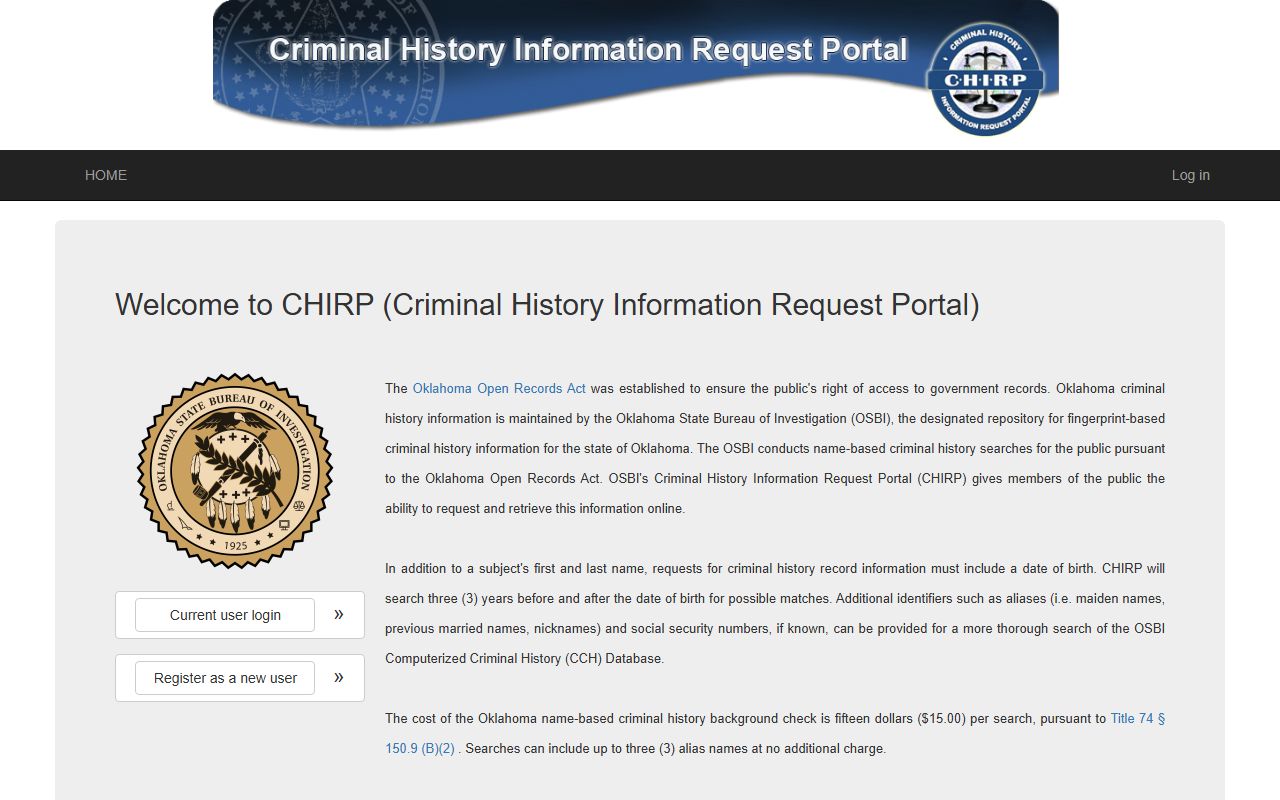
The portal walks a user through making an account and entering the subject's details before a report is returned. A CHIRP search costs $15 per criminal history and requires the subject's date of birth. Alias names can be added as options. The search is name based, so it pulls statewide records rather than a single county file. It is not a live jail roster or a warrant line.
Beaver County Criminal Background Checks
People often run a background check before hiring, renting, or trusting someone with a role. A casual ODCR search works fine for personal knowledge. A formal background check that affects employment or housing follows stricter federal rules and should use an authorized provider.
The current request tool is the CHIRP application landing page.
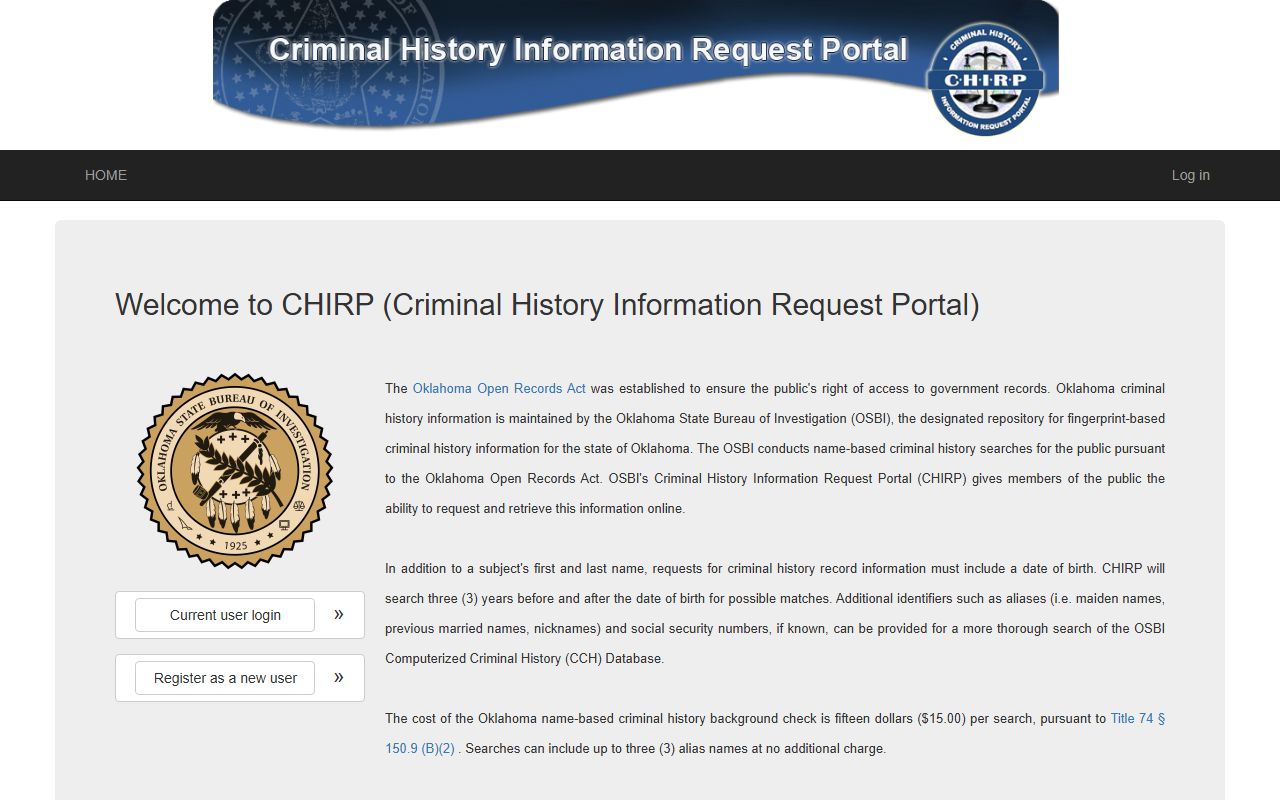
From there, a user signs in and submits a name and date of birth to order an official Oklahoma criminal history report. The result is a state record, which carries more weight than a quick docket scan for any decision that matters.
Important: This website is not a consumer reporting agency under the Fair Credit Reporting Act, and its records may not be used for credit, employment, tenant, or insurance screening.
Sealed vs Expunged Records
Some criminal records leave public view through sealing or expungement. The two are related but not identical. A sealed record is hidden from ordinary public access. An expunged record is treated as though it never existed, though some agencies keep limited access.
| Sealed | Expunged | |
|---|---|---|
| Visibility | Hidden from public | Treated as never existed |
| Law Enforcement | Limited access | Very limited access |
| Eligibility | Set by 22 O.S. §§ 18-19 | 22 O.S. §§ 18-19; juveniles under 10A O.S. § 2-6-109 |
| Process | Petition and court order | Petition and court order |
An eligible person files a petition in the District Court that handled the case. The court notifies the prosecutor and the agencies that hold records, and it may hold a hearing. If granted, the judge orders the clerk and the listed agencies to seal or expunge the file. Juvenile records follow their own path under 10A O.S. § 2-6-109. The change is not instant, and the Court Clerk can explain local filing cost and forms.
Note: A sealed or expunged case may not appear in an ODCR or OSCN search at all, so a missing case is not always proof that none was ever filed.
Public Access to Beaver County Criminal Records
Oklahoma treats most court records as open to the public. The Open Records Act lets people inspect and copy records during business hours unless a law makes them confidential. Criminal case files are public, but online access is not the same as the full official file. Certified copies and older documents come from the Court Clerk. These criminal files sit beside the county's civil, family, and probate files in the broader Beaver County court records system.
Key Statutes:
Oklahoma Statutes 51 O.S. §§ 24A.1-24A.30 - the Open Records Act, which keeps court records open unless sealed or made confidential by law.
Oklahoma Statutes 22 O.S. §§ 18-19 - sets when eligible criminal records can be sealed or expunged by court order.
Oklahoma Statutes 74 O.S. § 150.9 - lets OSBI provide name-based criminal history searches to the public for a fee.
Restricted Beaver County Criminal Records
Not every criminal matter is open. Juvenile cases are restricted by Oklahoma law, even though the District Court has juvenile jurisdiction. Sealed and expunged cases drop out of normal searches. Some mental health proceedings carry confidential medical details, and personal identifiers like Social Security and account numbers are redacted under court filing rules.
When a case is restricted, access usually requires the subject, an attorney with authority, an agency with a legal need, or a court order. The Court Clerk can explain what is available and what the law withholds. For active arrest matters and missed court dates, the Sheriff and the case docket are the better starting points.